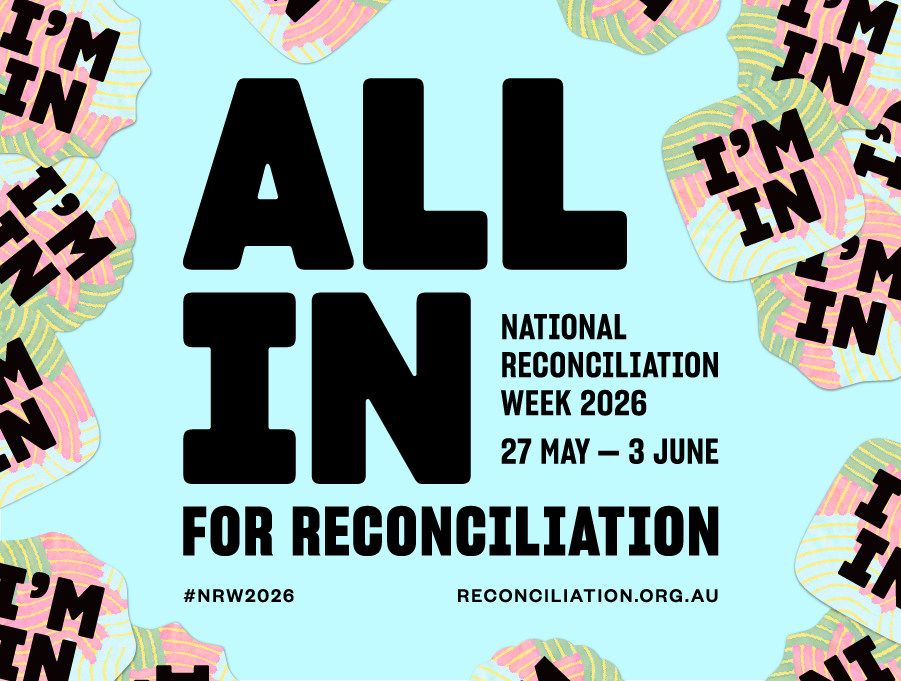
National Reconciliation Week (NRW) is a time for all Australians to learn about our shared histories, cultures, and achievements, and to explore how each of us can contribute to achieving reconciliation in Australia.
Find an event near you or upload your own, to be All In for NRW 2026.
All In for National Reconciliation Week 2026
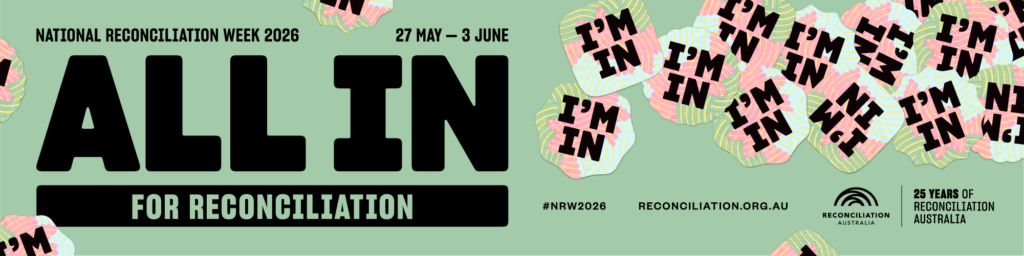
The theme for National Reconciliation Week 2026 is All In, a call for all Australians to commit wholeheartedly to reconciliation every single day.
All In makes clear that reconciliation is not a spectator sport and that all of us must step away from the sidelines and take action to make change.
The theme also reminds us that reconciliation and advancing Aboriginal and Torres Strait Islander peoples’ rights isn’t a passive activity, and it is not solely the responsibility of First Nations people, who have carried the weight of championing, explaining and acting for far too long.
Reconciliation will not happen by itself, and it will not happen without all of us.
The #NRW2026 campaign was created in collaboration with Carbon Creative, a First Nations-owned and operated marketing and creative agency.
Events, resources and choirs
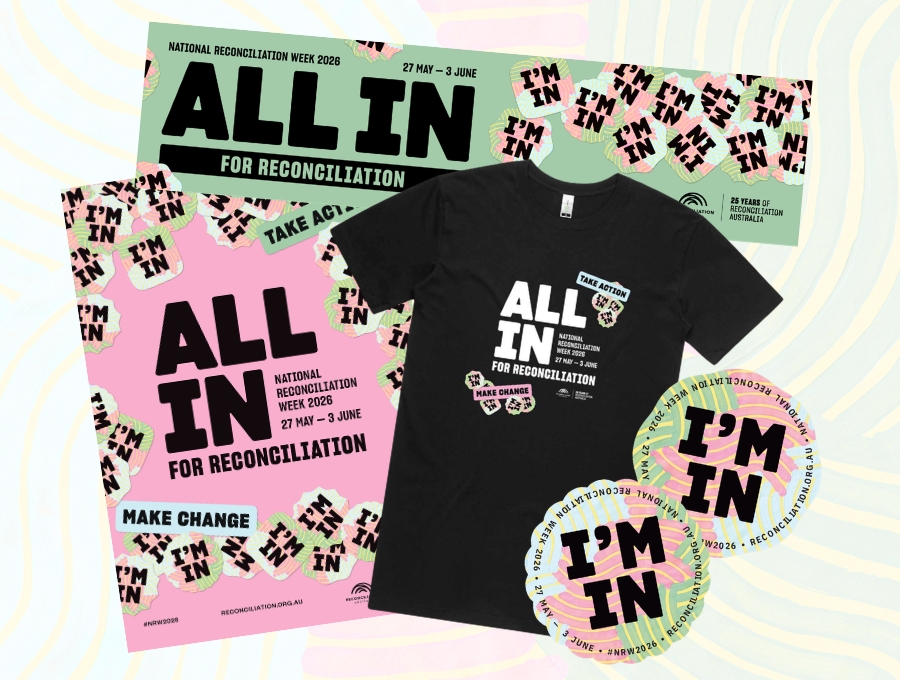
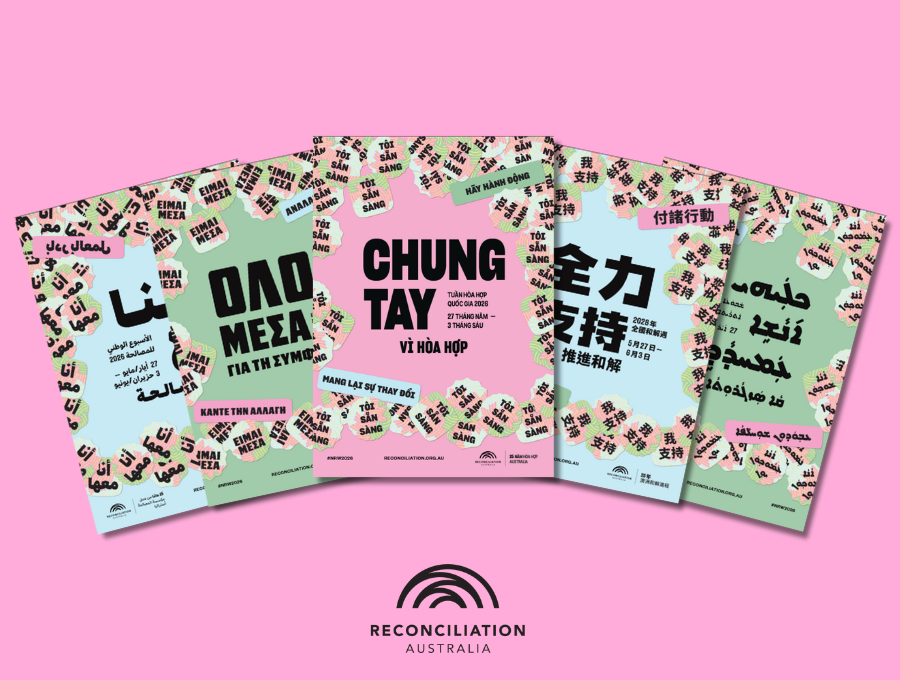
Posters and social tiles are available now from the posters and resources page. More resources will be added in the lead-up to NRW, so stay tuned.
Posters, colouring sheets and social tiles in 13 languages other than English are available now from the translated resources page.
The Voices for Reconciliation 2026 song is Midnight Oil classic Beds Are Burning.
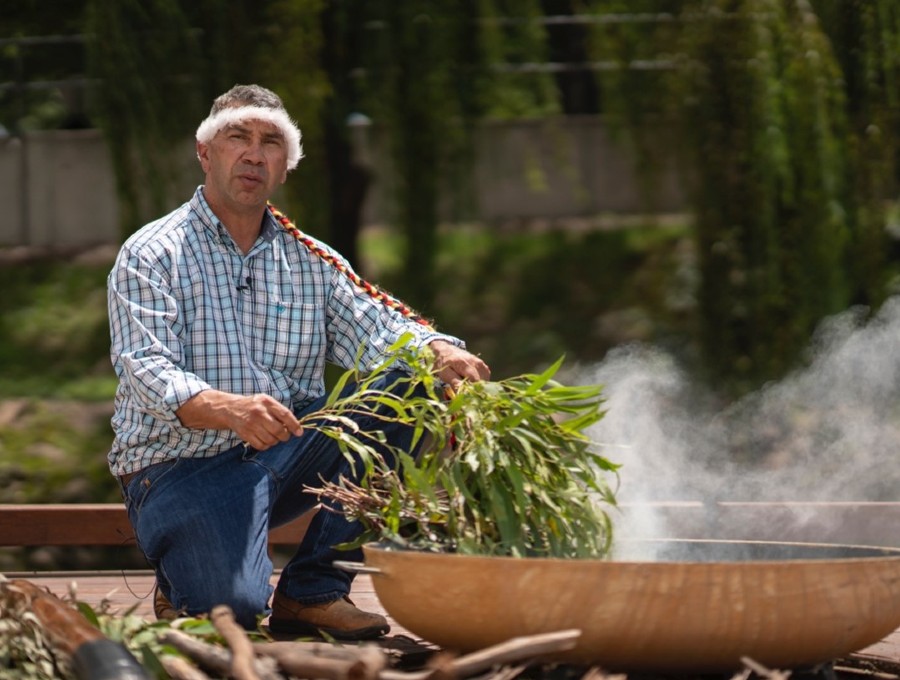
Paul Girrawah House has multiple First Nation ancestries from the South-East Canberra region, including the Ngambri-Ngurmal (Walgalu), Pajong (Gundungurra), Wallabollooa (Ngunnawal) and Erambie/Brungle (Wiradyuri) family groups.
Paul acknowledges his diverse First Nation history, he particularly identifies as a descendant of Onyong aka Jindoomang from Weereewaa (Lake George) and Henry ‘Black Harry’ Williams from Namadgi who were both multilingual, essentially Walgalu-Ngunnawal-Wiradjuri speaking warriors and Ngunnawal–Wallaballooa man William Lane aka ‘Billy the Bull’ - Murrjinille.
Paul was born at the old Canberra hospital in the centre of his ancestral country and strongly acknowledges his First Nation matriarch ancestors, in particular his mother Dr Aunty Matilda House-Williams and grandmother, Ms Pearl Simpson-Wedge.
Paul completed a Bachelor of Community Management from Macquarie University, and Graduate Certificate in Wiradjuri Language, Culture and Heritage and Management from CSU.
Paul provided the Welcome to Country for the 47th Opening of Federal Parliament in 2022. Paul is Board Director, Ngambri Local Aboriginal Land Council, Member Indigenous Reference Group, National Museum of Australia and Australian Government Voice Referendum Engagement Group.
Paul works on country with the ANU, First Nations Portfolio as a Senior Community Engagement Officer
Acknowledgement of Country
Reconciliation Australia acknowledges Traditional Owners of Country throughout Australia and recognises the continuing connection to lands, waters and communities. We pay our respect to Aboriginal and Torres Strait Islander cultures; and to Elders past and present.
Aboriginal and Torres Strait Islander peoples should be aware that this website contains images or names of people who have passed away.